
The Sandstone Collection at Villa Resorts
There’s a point where wine stops being about where it’s from.
In the Maldives, that shift happens quickly. Heat changes structure. Salt air softens edges. Even the pace of a meal alters how something shows in the glass.
At Villa Resorts, the Sandstone collection sits exactly in that space. Produced in South Africa, but shaped for the conditions it’s poured into, it brings together two environments that rarely meet in practice.
Not as a contrast. More as an adjustment.
The wines come from Elgin and Constantia, coastal regions where cooler conditions slow ripening and hold acidity in place.
That detail carries through.
In warmer climates, wines with too much weight tend to flatten. Structure disappears, and what feels balanced elsewhere can become heavy by the second glass. The Sandstone range avoids that entirely. It leans into restraint, keeping things clean and deliberate rather than expressive for its own sake.
The collection itself stays focused.
Two whites, a Sauvignon Blanc and Chardonnay. Two reds, Pinot Noir and Merlot. A rosé, alongside sparkling wines produced using the traditional méthode Cap Classique. There’s no attempt to broaden the list beyond what fits.
Each wine sits where it needs to.
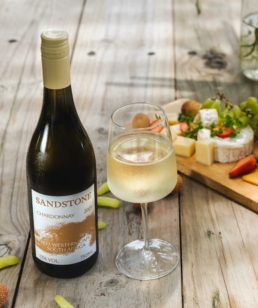
What defines the Sandstone collection?
The Sandstone collection is a curated range of South African wines developed for Villa Resorts, selected for freshness, balance and compatibility with the Maldives’ climate and cuisine.
The idea behind it isn’t variety.
It’s alignment.
Food across Villa Resorts moves between international dishes and lighter, ingredient-led menus shaped by the setting. Seafood plays a central role. So do vegetables grown on the islands, often prepared simply.
The wines follow that.
Acidity becomes more important than weight. Texture matters more than intensity. Even the reds stay controlled, avoiding anything that would overpower the food or the setting.
It’s not a list built to impress.
It’s built to stay in place.
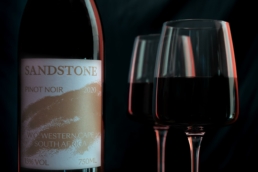
Why does freshness matter here?
Freshness is key in the Maldives, where climate affects how wine develops. Shorter production-to-service timelines help preserve structure, flavour and balance.
Time behaves differently here.
The longer a wine sits, the more it loses what makes it suited to this environment. That’s why the gap between vineyard and table matters more than it would elsewhere.
Some of the wines in the Sandstone collection come from recent vintages that were still on the vine less than a year before being poured.
That immediacy shows.
Fruit stays intact. Structure holds longer through the meal. There’s less need to work around the wine, and more room for it to sit naturally alongside the food.
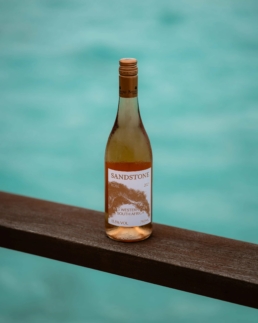
Who shaped the collection?
The collection was curated by German sommelier Kent Scheermeyer, who has spent over 25 years working in South Africa’s wine industry.
Scheermeyer’s starting point wasn’t the vineyard.
It was the setting.
After working in Cape Town for over two decades, he understood how the wines should behave at source. What stood out, on arriving in the Maldives, was how different the conditions were once they reached the table.
“The wines needed to feel fresher,” he says.
Not in a technical sense. In how they carry through a meal, in how they respond to heat, in how they sit alongside food that isn’t built around richness.
The result isn’t a larger list.
It’s a clearer one.
The Sandstone collection doesn’t try to translate the Cape into the Maldives.
It adjusts to it.
What begins in one landscape finishes in another, shaped less by origin and more by how it’s experienced once it arrives.
That’s where it makes sense.
Related Posts
Private Dining at Royal Island
A guide to private dining at Royal Island in Baa Atoll, from candlelit beach…
Hook at Villa Nautica: Seafood Worth Dressing Up For
Hook is Villa Nautica’s seafood restaurant for slow, polished evenings. Expect…

Ristorante al Tramonto: Italian Soul, Maldivian Sunset
There’s something almost cinematic about arriving at Ristorante al Tramonto.…